
The Places Mesh: Why a Map of Your Family's Real Life Beats Live Tracking
Open any major family tracking app and you'll see the same thing: a map, and a dot. The dot is your kid. It moves. You watch it.
That interface made sense when GPS was new and smartphones were expensive. It was remarkable just to see where someone was in real time. But ten years later, the live dot has become a crutch. And for a lot of families, it's causing more anxiety than it's relieving.
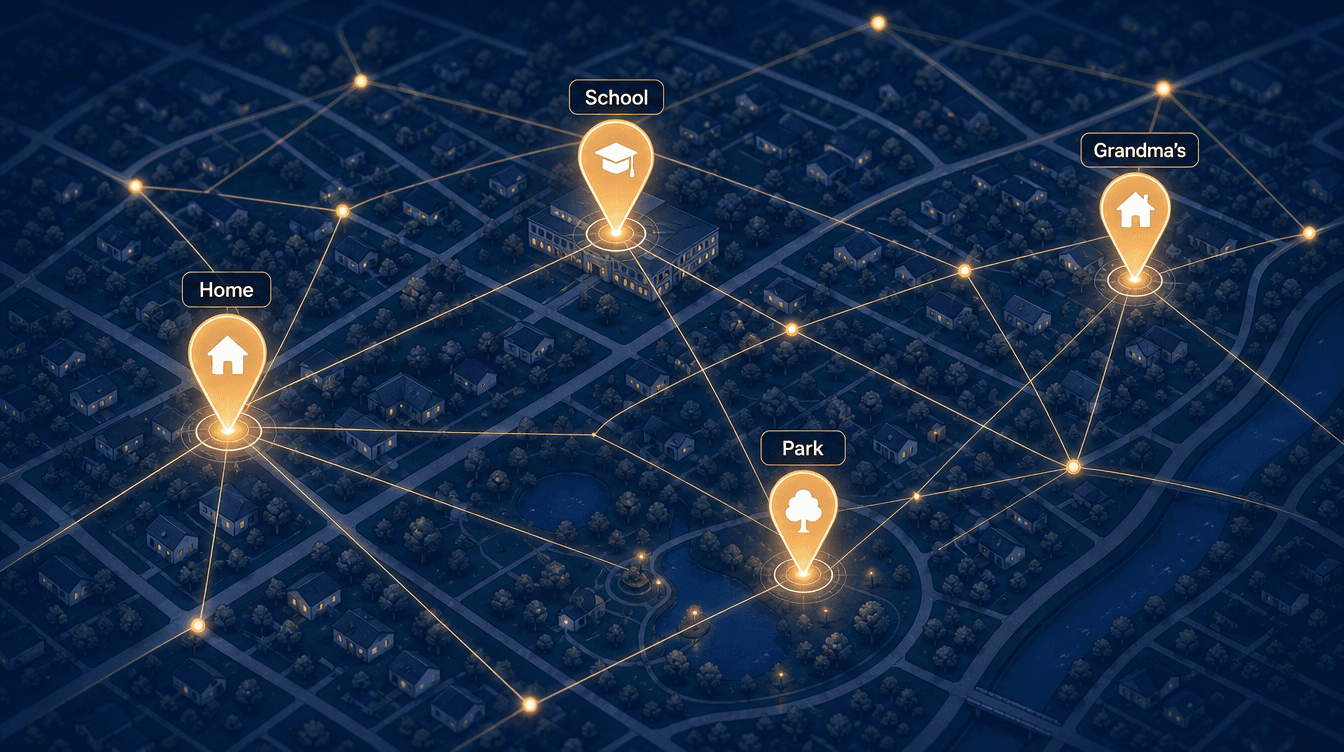
KinLink was built around a different idea. We call it the Places Mesh.
What the Places Mesh is
The Places Mesh is a growing network of named, geo-fenced locations that you build over time. Home. School. Grandma's house. The soccer field. Your teen's part-time job. The library. The mall.
Each Place is a named location with a radius. When the person you're tracking enters or exits that radius, you get a notification. Not a coordinate. Not a pin on a map that you have to interpret. A notification that says: Madison arrived at School. 7:52 AM.
That's it. You don't need to open the app. You don't need to interpret anything. The app told you what you needed to know, in plain language, and then it went quiet.
Why named places beat a live dot
Consider what you're actually asking when you check a family tracking app. You're not asking "what are the exact GPS coordinates of my child?" You're asking one of a few questions: Did they get there safely? Are they where they said they'd be? Have they left yet?
A live dot forces you to answer those questions yourself. You look at the dot, you compare it to a mental map, you try to figure out if that location is the school, the mall, or somewhere in between. You check again five minutes later because the dot moved and you're not sure what it means.
Named Places answer those questions for you. The app knows where school is because you told it. The app knows your teen arrived because the GPS matched the geo-fence. The app sent you a notification in plain language. You're done.
The Places Mesh turns the app's job into something it can actually do well, and frees you from having to watch a screen.
The mesh grows with your family
This is where it gets interesting. A Places Mesh isn't something you set up once and forget. It grows.
Every check-in your family member sends from a location you haven't named yet is an opportunity. When you receive that check-in, one tap creates a new Place at that exact location. Over time, the app builds a map of your family's real world. Not a generic street map. Your map. The places that actually matter in your family's life.
After a few weeks of normal use, you might have twenty Places saved. After a few months, you might have forty. Every new Place makes the app more useful, because every new Place is a location where you'll automatically get arrival and departure alerts without having to ask.
The mesh grows naturally. You don't have to manage it.
Private Places
One of the features we're most proud of is Private Places: geo-fences that are visible to the Guardian but invisible on the Dependent's map.
A Private Place still triggers arrival and departure alerts. Your family member just doesn't see the fence on their side of the app. This gives Guardians an additional layer of awareness without creating a sense of being watched at every turn.
The difference in practice
Here's what a Monday morning looks like with a live dot app:
You open the app at 7:45 AM. Your teen is still at home. You check again at 8:15. The dot is moving. You try to figure out if they took the right route. You check at 8:30 and they're... somewhere near the school? Or is that a side street? You're not sure. You check again at 8:45.
Here's what it looks like with KinLink:
At 8:22 AM, your phone buzzes. Madison arrived at Lincoln Middle School. You put your phone down and get back to your day.
That's the Places Mesh in practice. One notification. Complete information. No screen-watching required.
If that's what you've been looking for, KinLink launches October 1, 2026.

KinLink Team
KinLink
The KinLink team writes about family safety, trust, and the technology that helps families stay connected without the surveillance dynamic.